

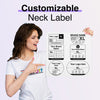
Custom Label XS / Style 6
$0.25


54 products
Custom neck labels are one of the most visible branding decisions you make as an apparel business. Woven labels require bulk minimums and long lead times. Screen-printed labels crack and fade after repeated washing. DTF-printed neck labels give you a third option: soft, full-color, high-resolution labels that apply with a standard heat press — with no minimum order requirement. At ZizoDTF, we produce custom DTF labels at 1800 DPI resolution from our Schaumburg, IL facility. Whether you are launching your first clothing line and need a dozen test labels, or you are scaling an established brand and need consistent results across hundreds of garments, the process is the same. Upload your design, choose your size, and receive print-ready DTF transfers ready to apply. DTF-printed labels sit flat against the skin, contain no scratchy woven threads, and hold full-color artwork — including gradients, photographic detail, and fine-line text — at any size. For brands moving toward a tagless label experience, DTF is a practical and affordable path. Because DTF labels are simply small-format DTF transfers, you have full flexibility over shape, size, and design. Common label configurations include: For most neck label applications, our 2x2 inch transfers and 3x3 inch transfers are the most common sizes. If you are printing multiple label designs at once, our gang sheets let you combine several label sizes and designs on one sheet to reduce your per-unit cost. Ordering is a three-step process: Not sure where to start? Request a free sample to see print quality on your fabric before placing a full order. To achieve clean, legible results at neck label sizes, keep the following in mind when preparing your artwork: DTF label pricing follows the same per-square-inch structure as our standard transfers — there is no label-specific surcharge. Because labels are typically small (2x2 or 3x3 inches), they are among our most cost-effective products per unit. Ordering multiple label designs on a single gang sheet reduces your per-label cost further. There are no setup fees and no minimum order quantities. You can order one label to test placement and print quality on your garment before committing to a production run. View our DTF supplies page for application accessories including protective sheets and silicone pads. Pricing is calculated at checkout based on your selected size and quantity. Free shipping applies to orders over $100. Woven labels are manufactured from thread on industrial looms and require minimum orders typically starting at 100 to 500 pieces. DTF neck labels are printed digitally using the same Direct-to-Film process as standard garment transfers, then applied with a heat press. DTF labels support full-color artwork, require no minimums, and can be ordered and received in days rather than weeks. The trade-off is that woven labels have a traditional textile feel; DTF labels are smooth and flat against the skin. Yes. DTF transfers are applied by heat-bonding a thin film layer directly to the fabric surface. The result is a smooth, low-profile print with no raised edges or scratchy backing. Many apparel brands use DTF labels specifically to replace woven tags and deliver a tagless experience. Print softness increases slightly after the first wash as the film fully integrates with the fabric weave. With proper care — machine wash cold, inside out, and tumble dry low — DTF labels hold up well through 40 or more wash cycles. Avoid bleach and high-heat dryer cycles, which can degrade the adhesive bond over time. For the most accurate durability assessment for your specific garment and washing conditions, we recommend ordering a free sample and running your own wash test before committing to a production run. Most neck labels fall in the 1.5x1 inch to 3x2 inch range. Our 2x2 inch transfer is the most popular choice for center-back collar labels. Our 3x3 inch transfer accommodates slightly larger brand marks or labels that include both a logo and care/size information. If you are unsure, order a sample in both sizes to compare placement and readability on your garment before your full production run. Yes. DTF printing supports any combination of graphics and text on a single label. A common configuration is a brand logo at the top with care symbols or size callouts below. Keep in mind that very small text (under 6pt) may lose legibility at 2x2 inches. Preview your design at actual print dimensions before submitting to confirm all text elements read clearly. No special equipment is required. A standard clamshell or swing-away heat press works well for DTF label application. Recommended settings are 300–325°F, 10–15 seconds, medium pressure, with a protective sheet over the transfer. Allow the label to cool completely before peeling. Avoid using a household iron, as it cannot maintain consistent temperature and pressure across the transfer area. Yes. If you are using a gang sheet, you can include both neck labels and full-size garment transfers on the same sheet, provided the total dimensions fall within your chosen gang sheet size. This is an efficient way to minimize per-design costs when you need both label stock and garment transfers for a collection launch or production run. PNG with a transparent background is the preferred format for label designs. JPEG and TIFF files are also accepted. For transparent or die-cut label shapes, PNG is required — JPEG does not support transparency. Submit your file at 300 DPI or higher at the intended print size for the sharpest output. Our production system prints at 1800 DPI, so a high-resolution source file gives you the best final result.
Learn More About Custom DTF Labels ▼
Why DTF Neck Labels?
Label Styles Available
How to Order Custom Labels
Design Requirements
Pricing
Frequently Asked Questions
What is the difference between a DTF neck label and a woven label?
Are DTF labels soft enough to use as tagless neck labels?
How many washes will a DTF neck label withstand?
What size should I use for a neck label?
Can I print care instructions and size information on the same label?
Do I need a special heat press to apply DTF labels?
Can I order labels and standard DTF transfers in the same order?
What file format should I use for my label artwork?


