
What Is DTF Printing? Complete Guide for Beginners
Jul 17, 2025 (Updated on Mar 12, 2026)
What Is DTF Printing? Complete Guide for Beginners
DTF printing — short for Direct to Film printing — is a method of transferring full-color designs onto fabric using a special printed film and heat press. A design is printed onto a PET film sheet, coated with a hot-melt adhesive powder, and then heat-pressed directly onto a garment. The process works on virtually any fabric — cotton, polyester, blends, and more — with no color limitations and no minimum order requirements.
So you've been hearing about DTF printing and you're wondering what all the fuss is about. Maybe you're a small business owner looking for a better way to create custom apparel, a print shop operator thinking about adding a new service, or just someone who wants a single custom shirt without dealing with minimum order hassles. Don't worry — by the end of this guide, you'll know exactly how DTF printing works, what it costs, and whether it's the right fit for what you're doing.
We cover everything here at Zizo DTF, so we know this space inside and out. Let's break it down together, step by step.
How DTF Printing Works: Step-by-Step Process
DTF printing gets its name from the film it uses as a temporary carrier — the design goes directly to film before it ever touches the fabric. Here's what the full process looks like, from file to finished garment.
1
Design Preparation
Your artwork is prepared as a high-resolution digital file — PNG with a transparent background works best. The standard printing resolution is 1800 DPI, which captures fine lines, gradients, and photographic detail with sharp clarity. If you're working with a basic design, 300 DPI at your intended print size is the minimum to aim for.
2
Printing onto PET Film
The design is printed onto a clear PET (polyethylene terephthalate) film using a DTF printer loaded with CMYK inks plus a dedicated white ink channel. The white ink is printed as an underbase layer beneath the colors — this is what allows DTF transfers to show true, vibrant colors on dark fabrics. Without that white underbase, dark shirts would absorb the color and the design would look muddy.
3
Hot-Melt Powder Application
While the ink is still wet, a hot-melt adhesive powder is applied evenly across the printed surface. This powder is what bonds the transfer to the fabric fibers. It's then cured in an oven or with a heat gun — typically at around 320°F (160°C) for 2 minutes — to melt and activate the adhesive. The result is a dry, flexible film ready for heat pressing.
4
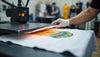
Heat Press Application
Place the transfer face-down on your garment. Set your heat press to 305–320°F (152–160°C) and press for 10–15 seconds with medium-to-firm pressure. For polyester fabrics, use the lower end of that range to avoid scorching. Pre-pressing the garment for 3–5 seconds beforehand removes any residual moisture, which leads to better adhesion. (For a detailed walkthrough of settings per fabric type, check our DTF heat press settings guide.)
5
Cold Peel
After pressing, let the transfer cool for 5–10 seconds before peeling the film away. Peel slowly and at a low angle — this is called a cold peel, and it's important. Peeling while the transfer is still hot can pull the design away from the fabric before the adhesive has fully bonded. And that's all! The design is now permanently part of the garment.
The whole application process — from placing the transfer to peeling the film — takes less than two minutes. That's one reason DTF printing is so popular for print-on-demand operations and small shops where speed matters.
DTF Printing Pros and Cons
DTF isn't perfect for every single situation, so let's be straightforward about where it shines and where other methods might be worth considering.
Pros
- Works on virtually any fabric — cotton, polyester, blends, nylon, spandex. No fabric restrictions.
- Full-color printing at no extra cost — unlimited colors in a single pass, including gradients and photographic images.
- No minimums — order one transfer or one thousand. Same process, same quality.
- Great for dark fabrics — the white ink underbase ensures colors look accurate regardless of garment color.
- No screen setup cost — unlike screen printing, there are no plates or screens to pay for per design.
- Soft hand feel — modern DTF prints have a thin, flexible feel on the garment when applied correctly.
- Durable results — with proper care, transfers maintain quality through 40+ wash cycles.
- Fast turnaround — no curing time between colors, no setup between designs.
Cons
- Requires heat press equipment — you need a heat press (or a transfer service) to apply the design.
- Not ideal for very large runs — at very high volumes (thousands of identical designs), screen printing may be more cost-effective per piece.
- Not a direct-to-garment method — you're printing to a transfer first, then applying it. Some fine-art prints require DTG instead.
- Proper care extends life — wash inside out, cold water, gentle cycle for longest durability.
For most small businesses, print shops, and independent creators producing custom apparel in small to mid-size runs — DTF printing is the practical sweet spot of cost, quality, and flexibility. Feel free to experiment with order sizes to find what works for your workflow.
What Can You Print with DTF Transfers?
One of the most common questions we get is about what you can actually print — and the short answer is: quite a lot. DTF transfers are more versatile than most printing methods when it comes to both the types of designs and the types of products you can decorate.
Fabric Compatibility
DTF transfers adhere to a much wider range of fabrics than alternatives like sublimation or HTV. Here's what you can work with:
- 100% Cotton — the most common garment fabric. DTF prints exceptionally well on cotton with vibrant, accurate color reproduction.
- 100% Polyester — great results, and unlike sublimation, DTF works on both light and dark polyester garments.
- Cotton-Polyester Blends — the most common fabric in performance and streetwear. DTF handles blends at any ratio with no issues.
- Nylon — works well with DTF, especially for athletic and outdoor gear.
- Spandex and Stretch Fabrics — DTF transfers flex with the fabric, which is why they're popular for athletic wear and yoga apparel.
- Canvas and Denim — heavier fabrics work too, though you may want to increase press time slightly for thicker materials.
The one thing DTF doesn't handle well is very loosely woven or highly textured fabrics where the adhesive can't make solid contact. For standard cut-and-sewn apparel, you're unlikely to run into any issues.
Product Types
Because DTF is a heat-press method, it works on any garment or textile item you can press flat — or close to flat — with a heat press. Common product types include:
- T-shirts (light and dark, all colors)
- Hoodies and crewneck sweatshirts
- Hats and caps (flat-bill styles work best; structured caps require a cap press)
- Tote bags and canvas pouches
- Aprons, uniforms, and workwear
- Pillowcases and soft home goods
- Pet apparel and accessories
- Performance shirts and leggings
Want to brand hard surfaces too — tumblers, laptop cases, phone covers, wood, metal, or glass? That's where UV DTF stickers come in. They use a similar transfer process but are specifically engineered for non-fabric surfaces, and they're waterproof and scratch-resistant right out of the box.
Not sure where to start? Try our free sample first.
Before committing to an order, grab our free sample pack — see the print quality and feel the hand feel on fabric yourself. No purchase required, US shipping only.
Get Your Free Sample Pack Browse Custom DTF TransfersDTF vs Other Printing Methods
So, what makes DTF different from everything else out there? Great question. Here's how it compares to the three methods you're most likely to be choosing between.
DTF vs Screen Printing
Screen printing is the oldest and most established garment decoration method — it uses mesh screens and squeegees to push ink directly onto fabric, one color at a time. It's the dominant choice for large volume runs of simple designs.
| Factor | DTF Printing | Screen Printing |
|---|---|---|
| Minimum order | None — order 1 piece | Typically 12–24 pieces minimum |
| Setup cost | None | Screen fee per color ($25–$40 each) |
| Color count | Unlimited — full color in one pass | Each color = separate screen and pass |
| Best for | Small batches, complex art, full color | Large runs, simple 1–3 color designs |
| Fabric compatibility | Virtually any fabric | Cotton and blends primarily |
| Cost at 12 pieces | Lower (no setup fees) | Higher (setup fees amortized over fewer pieces) |
| Cost at 500+ pieces | Comparable | Often lower per piece |
| Turnaround | 1–2 business days (transfer production) | Typically 7–14 days |
The bottom line: If you're printing fewer than 50 identical pieces, or if your design uses more than 3 colors, DTF will almost always win on cost and speed. Screen printing becomes more competitive at very high volumes with simple designs. Many shops now use both — DTF for small custom runs, screen printing for large uniform orders.
DTF vs Sublimation
Sublimation printing works by converting special inks into a gas that bonds with polyester fibers at high heat. It produces incredibly vibrant results — but only under specific conditions.
| Factor | DTF Printing | Sublimation |
|---|---|---|
| Fabric requirement | Any fabric type | 100% polyester (or poly-coated surfaces) only |
| Garment color | Light and dark garments | White or very light garments only |
| Hand feel | Slight texture (thin print layer) | No feel — ink becomes part of the fabric |
| Color vibrancy | Excellent, especially with white underbase | Exceptional on white polyester |
| All-over printing | Not ideal (heat press size limits) | Yes — full garment coverage possible |
| Setup complexity | Low — film + heat press | Moderate — requires sublimation printer and substrates |
| Cotton compatibility | Yes | No |
The bottom line: If you work with cotton, dark garments, or a wide variety of fabric types, DTF is the clear choice. Sublimation excels for all-over prints on 100% white polyester — like sports jerseys or custom activewear that needs edge-to-edge coverage. If you're decorating tumblers or mugs with UV DTF stickers, that's a different process entirely — but you get the idea.
DTF vs HTV (Heat Transfer Vinyl)
HTV — Heat Transfer Vinyl — involves cutting shapes out of colored vinyl sheets and heat-pressing the cut pieces onto garments. It's been a staple of small-batch custom apparel for years, and it's great for certain use cases.
| Factor | DTF Printing | HTV (Heat Transfer Vinyl) |
|---|---|---|
| Color capability | Unlimited — full photo-quality color | Solid colors; multi-color = multiple layers |
| Design complexity | Complex gradients, photos, fine lines | Simple shapes, text, bold logos |
| Production time | Fast — no cutting or weeding required | Slower — requires cutting and weeding vinyl |
| Cost for complex designs | Same price regardless of complexity | Increases with color count and design complexity |
| Feel on garment | Soft and flexible | Slightly stiffer vinyl feel |
| Fabric compatibility | Virtually any fabric | Most fabrics, but varies by vinyl type |
| Equipment needed | Heat press | Vinyl cutter (Cricut, Silhouette) + heat press |
The bottom line: HTV is hard to beat for simple, single-color designs — especially if you already own a cutting machine. But the moment your design has more than 2–3 colors, gradients, or any photographic elements, DTF is faster and cheaper. We wrote a full DTF vs HTV comparison guide if you want to go deeper on this one.
How Much Does DTF Printing Cost?
Pricing depends on whether you're ordering individual transfers or using gang sheets, how large your designs are, and your order volume. Here's a straightforward overview so you can budget before you order.
Individual DTF Transfers
Individual transfers are priced by size. You get one design per transfer, printed to exact dimensions. Here at Zizo DTF, we offer 17 standard sizes — here's a representative sample to give you a sense of the pricing range:
| Transfer Size | Typical Placement | Starting Price (each) |
|---|---|---|
| 2 x 2 inches | Neck labels, small logo patches | $1.00 |
| 4 x 4 inches | Left chest logo (most common) | $2.00 |
| 8 x 8 inches | Front center graphic | $5.00 |
| 10 x 10 inches | Full front design, retail apparel | $6.00 |
| 12 x 17 inches | Oversized front graphic | $8.00 |
No minimum orders, no setup fees, no surcharges for full-color designs. You pay the listed price whether your design has one color or twenty-five.
DTF Gang Sheets
A DTF gang sheet is a large 22-inch-wide print sheet where you arrange multiple designs side by side — maximizing the printable area to reduce your cost per design. If you regularly print 3 or more different designs, gang sheets are almost always the better value.
Gang sheet pricing is calculated by the square inch of the sheet, rather than per design. The economics work out to roughly $0.02 per square inch at standard sizes — significantly lower than individual transfer pricing on a per-design basis. If you've never built one before, our gang sheet beginner's guide walks you through the whole process. You can also use our online gang sheet builder to arrange your designs without any design software.
What Affects Your Total Cost?
- Design size: Larger designs use more film and ink — cost scales with area.
- Quantity: Volume pricing applies as order sizes increase.
- Sheet format: Gang sheets deliver lower cost per design than individual transfers when you have multiple designs to print.
- Shipping: Free on orders over $100. Standard shipping rates apply below that threshold.
Not sure what your order will cost before you commit? You can get a clear sense of pricing by browsing the DTF supplies section or using the size-based product pages to calculate totals. No surprises at checkout.
How to Get Started with DTF Printing
If you're new to DTF printing, the most common question is: where do I actually begin? Here's a practical getting-started path — whether you're planning to apply the transfers yourself or just want custom apparel printed and shipped.
Path 1: Order Ready-to-Apply DTF Transfers (No Printer Needed)
This is the most popular starting point for small businesses and creators. You upload your design, we print the transfers, and you apply them with your own heat press. Here's the flow:
- Prepare your artwork. PNG with transparent background, RGB color mode, 300 DPI minimum at your intended size. If you're working from a logo, export it from your design software at the transfer size you plan to order.
- Choose your format. Single design? Order an individual transfer at the size you need. Multiple designs? Build a gang sheet for better value per design.
- Upload and order. Use our online gang sheet builder or file upload to submit your design. Set your quantity — even 1 is fine. No setup fees.
- Apply your transfer. When your transfer arrives, follow our DTF heat press settings guide for temperature (305–320°F), press time (10–15 seconds), and peel method (cold peel).
- Care for your prints. Wash inside out in cold water, gentle cycle, mild detergent. Avoid bleach and high-heat dryers. Your aftercare guide has the full instructions for keeping prints looking their best across 40+ washes with proper care.
Path 2: Validate Quality First (Highly Recommended)
Not sure if DTF is right for your project? We strongly recommend ordering a free sample pack before placing a production order. You'll get actual printed transfers to touch, test the hand feel, run a wash test, and see the color accuracy in person — no purchase required. Seeing is believing when it comes to print quality.
Path 3: Add DTF Transfers to Your Print Shop Services
If you're already running a print shop or decoration business, DTF transfers let you expand your offerings without adding printing equipment. You order transfers from us (including us!), apply them with your existing heat press, and deliver finished garments to your customers. Gang sheets make it cost-effective at almost any volume. Many print shops use DTF to handle the short-run, full-color jobs that don't justify screen printing setup costs.
Ready to try it for yourself?
Start with a free sample or browse our full range of custom DTF transfers — no minimums, no setup fees, US-based printing from our Schaumburg, IL facility.
Get a Free Sample Pack Build a Gang SheetFrequently Asked Questions
What is DTF printing in simple terms?
DTF printing — Direct to Film printing — is a way to apply custom designs onto fabric using a printed film and a heat press. The design is printed onto a special film sheet, coated with adhesive powder, and then heat-pressed onto the garment. It works on virtually any fabric type and allows full-color printing with no minimum orders.
What equipment do I need for DTF printing?
To apply DTF transfers yourself, you need a heat press — that's it. The actual DTF printing (printer, film, inks, powder, curing) is handled by your transfer supplier. A basic heat press starts around $200–$400. If you're ordering ready-to-apply transfers from a supplier like us, you don't need any printing equipment at all.
How long do DTF prints last?
With proper care, DTF transfers maintain quality through 40+ wash cycles. Proper care means washing inside out in cold water on a gentle cycle, using mild detergent, no bleach, and tumble drying on low heat or air drying. Avoid ironing directly on the transfer. The longevity of your print depends heavily on following these care guidelines.
Is DTF printing good for beginners?
Yes — DTF printing is one of the most beginner-friendly custom apparel methods available. You don't need design software (our online gang sheet builder handles that), you don't need a minimum order, and the application process is straightforward once you have the right heat press settings. Anyone can do it. Our blog has step-by-step guides for every part of the process.
What's the difference between DTF and DTG printing?
DTG (Direct to Garment) printing prints ink directly onto the fabric without using a transfer film. DTG produces excellent results on 100% cotton and is great for detailed, photo-quality artwork. DTF uses a film transfer that works on a wider range of fabrics — including polyester, blends, and synthetic materials — and doesn't require pre-treatment of the garment. DTG is typically done on professional equipment in print shops; DTF transfers can be produced by a supplier and applied with a standard heat press at home or in your shop.